Annual Reports
Lyft, Inc.'s annual reports contain management's most considered account of the business. These are the sections, passages and visual pages worth opening in the originals preserved in Sources.
Lyft, Inc. — FY2025 Annual Report (Form 10-K) — FY2025
The latest 10-K and a genuine inflection: Lyft's second straight profitable year, a $2.9bn tax-driven net income, and its first move outside North America. · Open the full document →
Item 1. Business — p. 6 · Read the full section →
The identity reset: Lyft reframes itself from a US/Canada rideshare app to a global mobility platform spanning six continents.
Opening self-description and revenue model, now recast around a global, multimodal footprint.
Lyft, Inc. (the “Company” or “Lyft”) operates as a global mobility platform offering a mix of rideshare, taxis, private hire vehicles, executive chauffeur services, car sharing, bikes and scooters. […] Substantially all of our revenue is generated from our ridesharing marketplace that connects drivers and riders. We collect service fees and commissions from drivers for their use of our ridesharing marketplace. […] In 2025, we expanded our operations beyond North America and strengthened our global footprint. We entered nine new countries and more than 180 cities through our acquisition of Intelligent Apps GmbH (d/b/a Freenow) in July 2025, a leading European multimodal app with taxi offering at its core.
p. 6 · Read in context →
The competitive set, from Uber and Bolt to the AV entrants Waymo, Zoox and Tesla.
The market for Transportation-as-a-Service (“TaaS”) networks is intensely competitive and characterized by rapid changes in technology, shifting levels of demand and frequent introductions of new services and offerings. […] Our main ridesharing competitor is Uber and our main competitors for app-based intermediation services for taxi and private hire vehicles are Uber and Bolt, though we also compete with other TNCs, taxi cab and livery companies as well as traditional automotive manufacturers and technology companies.
p. 10 · Read in context →
Item 1A. Risk Factors — We may not be able to achieve or maintain profitability in the future — p. 21 · Read the full section →
Management's own reminder that two years of GAAP net income sit atop a decade of losses and could reverse.
On the fragility of Lyft's newfound profitability.
We achieved net income, on a GAAP basis, in the years ended December 31, 2024 and 2025, however, we incurred net losses every other year since our inception, and we may not be able to achieve or maintain GAAP profitability. We expect that our financial performance, including our net income and Adjusted EBITDA, will continue to fluctuate in future periods. We can provide no assurances that we will achieve or maintain profitability in the future, on a quarterly or annual basis.
p. 21 · Read in context →
Item 1A. Risk Factors — Our actual losses may exceed our insurance reserves — p. 29 · Read the full section →
Insurance is Lyft's single largest cost; reserves rest on actuarial guesses that rising auto-injury costs keep pressuring.
Item 1A. Risk Factors — Challenges to contractor classification of drivers — p. 67 · Read the full section →
The existential gig-economy question, now widened to Europe by the Freenow and TBR acquisitions.
Item 7. MD&A — Recent Developments — p. 95 · Read the full section →
The year in one screen: 15% Gross Bookings growth, a $2.9bn tax-driven net income, and two acquisitions that took Lyft global.
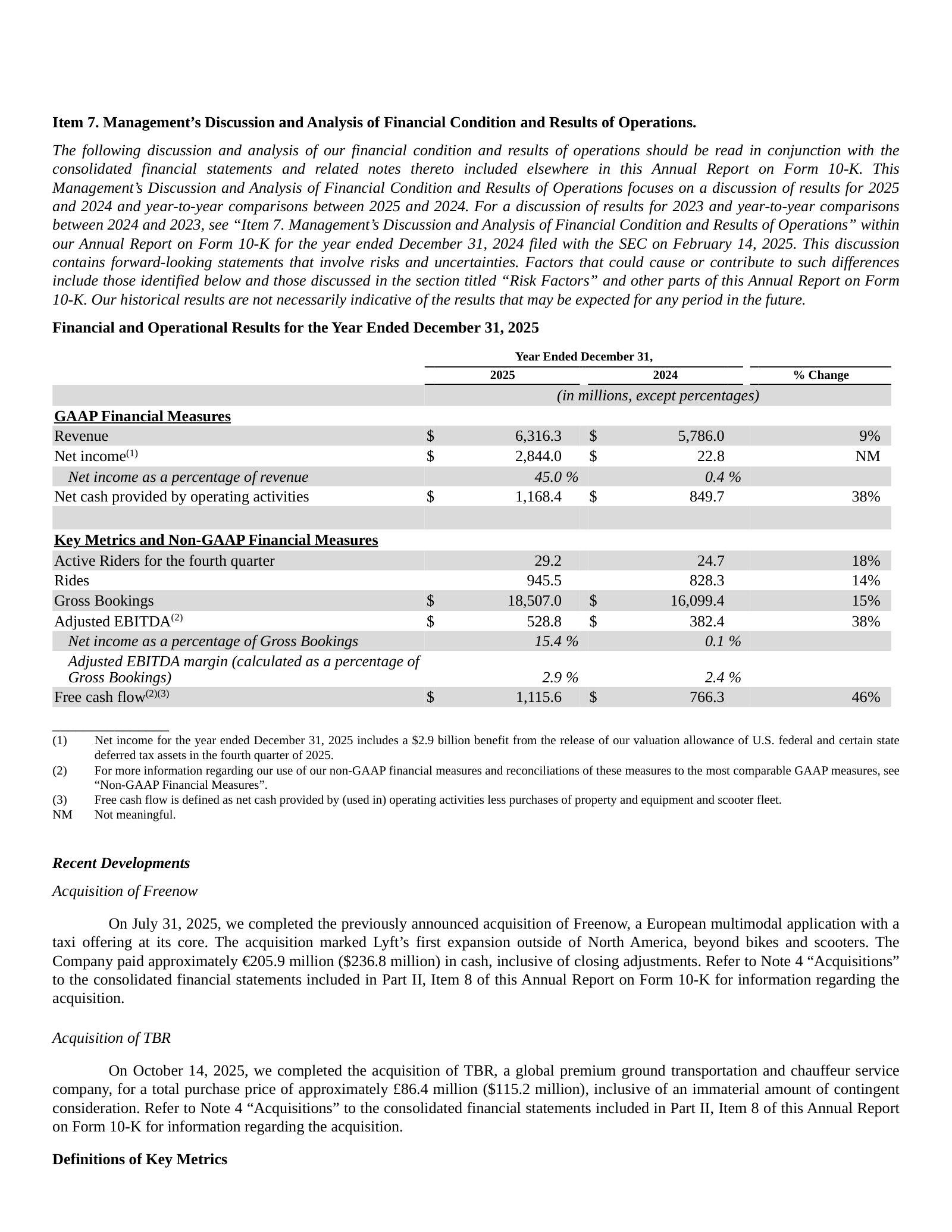
The Freenow and TBR deals — Lyft's first operations outside North America.
On July 31, 2025, we completed the previously announced acquisition of Freenow, a European multimodal application with a taxi offering at its core. The acquisition marked Lyft’s first expansion outside of North America, beyond bikes and scooters. The Company paid approximately €205.9 million ($236.8 million) in cash, inclusive of closing adjustments. […] On October 14, 2025, we completed the acquisition of TBR, a global premium ground transportation and chauffeur service company, for a total purchase price of approximately £86.4 million ($115.2 million), inclusive of an immaterial amount of contingent consideration.
p. 95 · Read in context →
Item 7. MD&A — Results of Operations — p. 102 · Read the full section →
Where the profit story meets reality: an operating loss beneath the headline net income, driven by climbing insurance costs.
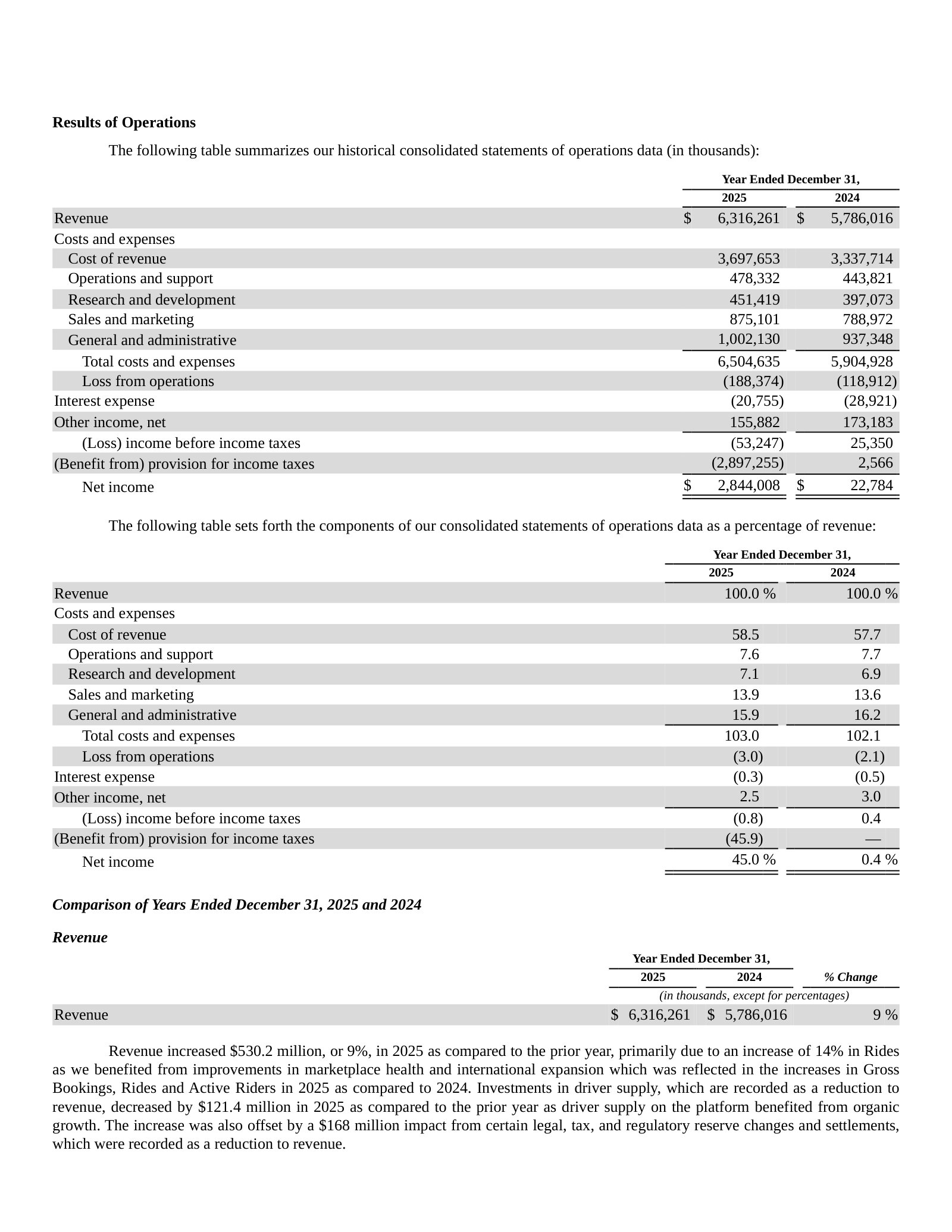
Insurance is the cost line to watch; California's SB 371 is management's hoped-for relief.
Cost of revenue increased $359.9 million, or 11%, in 2025 as compared to the prior year. The increase was primarily due to a $337.8 million increase in insurance costs driven by increased ride volume paired with higher costs per mile. […] We expect to see cost of revenue increase in the near term on a year-over-year basis due to higher insurance costs driven by recent economic factors and the renewals of our third party insurance agreements, but we expect total insurance costs will increase at a lower rate than they have historically as a result of a recently passed rideshare insurance reform bill, SB 371, which is expected to reduce our insurance rate in California.
p. 104 · Read in context →
Note 2. Summary of Significant Accounting Policies — Revenue Recognition — p. 137 · Read the full section →
The accounting choice that defines the model: Lyft books net (agent) revenue in most markets, gross (principal) where it controls the ride.
Agent vs principal — why reported revenue is a fraction of the fares riders actually pay.
The Company generates revenue from service fees and commissions (collectively, “fees”) paid by drivers for use of the Lyft Platform and related activities to connect drivers with riders to facilitate and successfully complete rides via the Lyft apps. […] In most cases, the Company is acting as an agent in facilitating the ability of a driver to provide a transportation service to a rider. In these cases, the Company reports revenue on a net basis, reflecting the fee owed to the Company from a driver as revenue, and not the gross amount collected from the rider. In certain markets, the Company acts as a principal for transportation services as the Company controls the services provided. Revenue generated in these markets is reported on a gross basis reflecting the gross amount collected from the rider, with payments to the drivers recorded within cost of revenue.
p. 137 · Read in context →
Lyft, Inc. — FY2024 Annual Report (Form 10-K) — FY2024
Included only for its business description, which still bounds Lyft to the US and Canada — the baseline the FY2025 global pivot departs from. · Open the full document →
Item 1. Business — p. 6 · Read the full section →
The pre-acquisition framing — Lyft as a US-and-Canada network — makes the FY2025 global pivot visible.
One year earlier, Lyft described itself strictly as a North American transportation network.
Today, Lyft is one of the largest multimodal transportation networks in the United States and Canada. […] Our ridesharing marketplace connects drivers with riders via the Lyft mobile application (the “Lyft App”) in cities across the United States and in certain cities in Canada.
p. 6 · Read in context →
More annual reports
Lyft, Inc. — FY2023 Annual Report (Form 10-K) — FY2023 · 223 pages · The last pre-profit year, covering the September 2024 restructuring and management transition. · Open →
Lyft, Inc. — FY2022 Annual Report (Form 10-K) — FY2022 · 167 pages · Peak-loss era; useful for the earlier cost structure and the April 2023 restructuring plan. · Open →
Lyft, Inc. — FY2021 Annual Report (Form 10-K) — FY2021 · 156 pages · The post-pandemic recovery year, with the original mission framing and Shared Rides still in wide use. · Open →